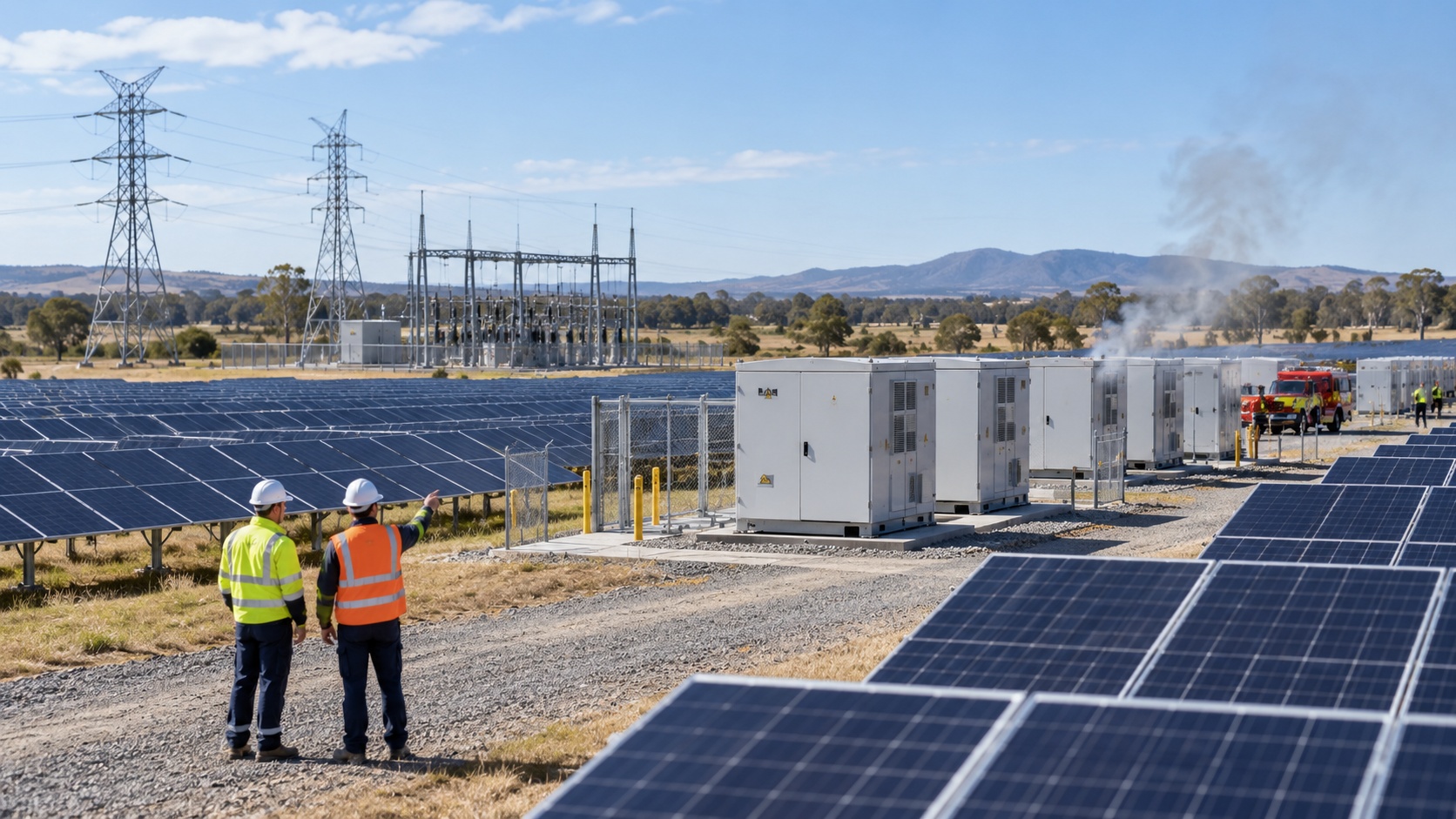
A February 2025 inverter fire at Raywood Solar Farm in Victoria has prompted renewed scrutiny of Sungrow Power Supply Co., Ltd.'s inverter reliability, safety controls and related disclosure to investors.
The incident occurred on February 20, 2025, when an inverter caught fire at the Raywood facility. Ten Country Fire Authority units attended the scene, and the fire was extinguished after the site was electrically isolated. Black toxic smoke also prompted a warning for the surrounding community.
Energy Safe Victoria later confirmed that the fire originated in electrical equipment and spread to nearby vegetation. Media reports identified the equipment involved as a Sungrow inverter. The technical cause of the fire has not been publicly disclosed.
The complaint submitted to HKEX argues that the unresolved cause of the fire, together with other reported inverter failures, warrants closer examination of whether the Raywood event was isolated or has wider relevance to Sungrow's inverter business.
Following the Raywood incident, Energy Safe Victoria directed Raywood and four other solar farms in Goornong, Ledcourt, Stawell and Moolort to stop generating electricity from February 22, 2025.
The regulator identified inadequate vegetation management and firebreak arrangements at the affected sites, which had to be addressed before generation could resume. All five projects were owned through Sungrow subsidiaries.
The filing notes that the directions remained in place as of March 13, implying a minimum publicly confirmed shutdown period of about 19 days. The five sites had approximately 25 MW of combined capacity.
Using a 30.3% grid-scale solar capacity factor and an average Victorian electricity price of about A$59/MWh, the complaint estimates potential foregone electricity revenue of approximately A$204,000, or RMB0.97 million, over the 19-day period. That estimate is presented as illustrative rather than an actual reported loss.
The complaint also cites a 2025 study examining repeated failures of Sungrow inverters at the Kopli Solar Power Plant in Estonia.
Researchers examined four severely damaged inverters and reported recurring damage involving isolation relays, semiconductor components and internal circuitry. Laboratory testing reproduced the same failure pattern.
These components are important because isolation relays are designed to open and close electrical circuits, while semiconductor devices regulate electrical current. Failures in either area can affect an inverter's ability to control or safely interrupt electrical flow.
The study also reported that during 44 days of monitoring, electrical current generally remained below 1,500 amps during normal operation but exceeded 3,000 amps during several fault events. Researchers linked the failures to slow relay response, weaknesses in semiconductor protection and insufficient control of electrical arcing.
The complaint does not claim that the Kopli failures establish the cause of the Raywood fire. Instead, it argues that the findings make it relevant to determine whether similar internal component or protection-system issues have been investigated across Sungrow's broader inverter fleet.
The filing also references a January 2024 incident at the Mannum Stage 2 Solar Farm in South Australia, where an electrical inverter unit inside a container failed or malfunctioned and caught fire during commissioning.
The project is described as a 30 MW solar farm equipped with Sungrow inverters, although available information cited in the complaint does not establish whether the fire resulted from an internal inverter defect, inadequate maintenance or another cause.
Ten firefighters attended the Mannum incident, a contractor required hospital treatment and the reported damage was approximately A$250,000, equivalent to about RMB1.19 million.
The complaint also cites a separate insurance case reported by Aviva in which an inverter fire damaged nearby photovoltaic modules and reduced plant capacity. That case included a reported £200,000 loss-of-revenue claim.
These examples are used as benchmarks for the types of direct damage and revenue losses that can arise from inverter-related incidents, rather than as evidence of Raywood's actual financial impact.
The filing presents an illustrative estimate of direct Raywood-related exposure totaling approximately A$454,000, or RMB2.17 million. That figure combines a potential A$250,000 physical-damage benchmark derived from the Mannum Stage 2 case with approximately A$204,000 of estimated lost generation across the five temporarily shut sites.
The complaint explicitly notes that this figure is not Sungrow's actual reported loss. It also excludes possible additional equipment replacement, remediation, investigation costs and third-party liabilities. Sungrow has not publicly disclosed the financial impact of the Raywood fire or the subsequent shutdowns, the filing says.
The broader issue is whether the Raywood incident has relevance beyond a single project.
Sungrow's photovoltaic inverter and other power-conversion business generated RMB31.14 billion of revenue in 2025, representing 35.0% of group revenue. The company also reported more than 660 GW of cumulative installed PV inverter capacity worldwide.
The complaint argues that if similar inverter issues were identified across additional projects, potential exposure could extend beyond isolated fire damage to include inspections, repairs, component replacements, warranty claims and other remediation.
It also notes that Sungrow's group warranty provisions increased from RMB2.53 billion in 2023 to RMB4.23 billion in 2024 and RMB5.57 billion in 2025, an increase of about 120% over two years. The filing treats that increase as relevant to assessing potential future warranty exposure, while not establishing that the rise was caused by Raywood or any particular inverter defect.
The Raywood fire occurred in February 2025, before the April 20, 2026 Latest Practicable Date used in Sungrow's Application Proof.
The complaint says the Application Proof includes general disclosure that product defects can lead to returns, recalls, warranty claims, product-liability claims, reputational damage and customer losses. However, it says the document does not specifically address the Raywood fire, its cause, its financial consequences or whether the underlying issue may have relevance beyond that site.
The filing refers to HKEX Listing Rules 11.07, 2.13 and 8.04 in asking whether investors have been provided with sufficient information to assess the company's activities, financial position and related risks.
The submission asks HKEX to consider whether Sungrow should provide the findings of the Raywood investigation, including the identified cause and any corrective measures taken.
It also seeks clarification on whether the company has identified or investigated similar internal inverter failures elsewhere, how frequently any such issues have occurred, whether inspections or repairs have been required, and whether there have been material warranty, replacement or remediation costs.
The significance for investors lies in the distinction between a site-specific event and a broader product-reliability issue.
If Raywood proves to be isolated, the impact may remain limited to individual project costs and temporary operational disruption. If similar issues are found across other installations, the potential implications could extend to warranties, maintenance obligations, customer confidence and future project procurement.
For now, the key unanswered issues remain the technical cause of the Raywood fire, the corrective actions taken and the extent of any related financial exposure.
Intelligence Takeaway
The signal is less about a single headline and more about how decision-makers should read the operating environment: commercial claims, policy exposure, and execution evidence now need to be evaluated together.