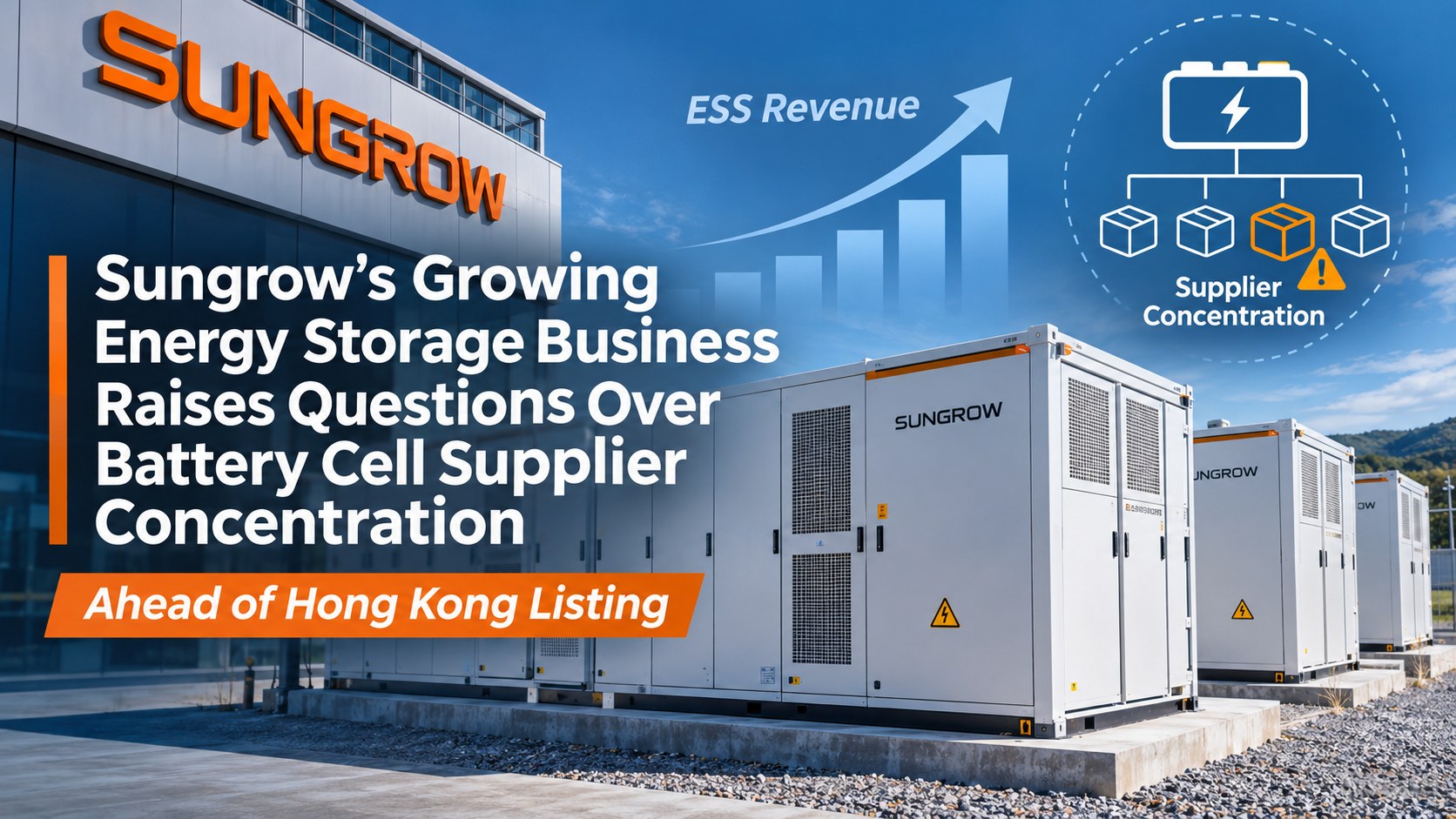
Sungrow Power Supply Co., Ltd. is facing questions over its dependence on external battery cell suppliers as its energy storage system (ESS) business becomes an increasingly important contributor to revenue ahead of its proposed Hong Kong listing.
The company's rapid expansion in energy storage has increased the significance of battery cell procurement, with four of its five largest suppliers in 2025 primarily supplying battery cells. One supplier accounted for approximately 65.5% of the combined purchase value of those four major cell suppliers, highlighting concentration within Sungrow's disclosed procurement relationships. An investor reviewing the proposed listing has called for more detailed disclosures on supplier concentration, alternative sourcing capacity and the potential financial consequences of supply disruptions.
Sungrow's energy storage business has expanded substantially over the past three years. ESS revenue increased from RMB17.80 billion in 2023 to RMB24.96 billion in 2024, before reaching RMB37.29 billion in 2025. Over the same period, the segment's contribution to total revenue rose from 24.7% to 32.1% and then 41.9%, making it Sungrow's largest business segment in 2025, ahead of photovoltaic inverters and other power conversion devices, which accounted for 35.0%. By the first half of 2026, ESS represented approximately half of Sungrow's total revenue.
The segment's increasing financial significance has made the reliability and cost of essential components, particularly battery cells, a more important consideration for investors assessing the company's growth prospects.
Unlike vertically integrated battery manufacturers, Sungrow does not manufacture its own battery cells. Instead, the company purchases them from third-party suppliers for integration into its energy storage systems. Its supplier qualification process includes selection, certification, sample testing and contractual approval, meaning that replacing a major battery cell supplier may require substantial preparation.
Procurement disclosures show that battery cell manufacturers have become increasingly prominent among Sungrow's largest suppliers. In 2023, only one of its five largest suppliers primarily supplied battery cells. That number increased to two in 2024 and four in 2025. Purchases from battery cell suppliers within the top five reached RMB10.58 billion in 2025, representing 22.3% of total company procurement, compared with RMB2.55 billion, or 5.1%, in 2023.
The largest disclosed supplier, identified as Supplier I, accounted for approximately RMB6.93 billion in purchases during 2025, equivalent to 14.6% of Sungrow's total procurement and approximately 65.5% of the combined purchases from the four battery cell suppliers appearing among its five largest suppliers. However, the figures do not establish the supplier's share of Sungrow's total battery cell purchases because a complete breakdown of battery cell procurement has not been disclosed.
Comparisons with other public disclosures suggest that Supplier I may be CALB, while other major battery cell suppliers may include CATL, Sunwoda Electronics and REPT BATTERO. These identifications are based on matching procurement figures and should not be treated as confirmed identities in the listing application.
Sungrow has taken steps to strengthen relationships with existing battery cell manufacturers while exploring additional sourcing arrangements. In July 2026, the company invested RMB655 million in Sunwoda Power and jointly developed a 684Ah battery cell used in its PowerTitan 3.0 energy storage system. The investment reflects closer cooperation with an established battery supplier, although it does not independently demonstrate that Sungrow has reduced its reliance on its largest procurement partner.
Several suppliers have also faced legal or regulatory disputes. Sunwoda was subject to three German patent injunctions in 2025 involving restrictions on specific battery products. Those disputes were resolved through a licensing agreement in June 2026. Separately, a subsidiary of Geely filed a RMB2.31 billion lawsuit against Sunwoda Power in December 2025 over allegedly defective electric vehicle battery cells. The dispute was settled in February 2026, with Sunwoda Power agreeing to pay RMB608 million toward previous replacement costs and share future expenses.
EVE Energy, another battery manufacturer identified as an important supplier to Sungrow, became subject to a U.S. patent investigation in August 2026 involving certain cylindrical batteries and products containing them. There is no public evidence establishing that the battery cells involved in the Geely dispute or EVE Energy's U.S. investigation are used in Sungrow's ESS products. Nevertheless, restrictions affecting relevant suppliers or technologies could create additional procurement and qualification challenges if they disrupt the availability of components required for Sungrow's energy storage projects.
Sungrow has also reportedly explored sourcing battery cells from non-Chinese manufacturers for its U.S. energy storage business. In September 2026, ESS News reported that Sungrow planned to procure battery cells from South Korea's Samsung SDI for U.S. projects. Neither company had publicly confirmed the arrangement, while procurement volumes, pricing and delivery schedules remained undisclosed.
Such sourcing could potentially reduce exposure to Chinese battery cell manufacturers. However, using non-Chinese cells would not automatically resolve broader U.S. regulatory requirements. Eligibility for investment tax credits under Section 48E depends on applicable conditions, including requirements affecting the wider energy storage system rather than battery cells alone. U.S. national-security and equipment-authorization considerations may also extend to software, communications systems and other components. As a result, diversifying battery cell procurement would not necessarily establish regulatory eligibility for complete Sungrow ESS installations in the United States.
The operational implications of battery cell concentration extend beyond the immediate availability of components. Replacing a supplier can involve technical qualification, engineering adjustments, additional testing and contractual renegotiations. Industry information cited in the investor's analysis indicates that testing individual 314Ah battery cells typically requires three to six months. A Sungrow key account manager covering the Middle East and Africa estimated that changing suppliers after factory acceptance testing could take approximately one year, including engineering modifications and contract renegotiations.
These timelines suggest that a disruption involving a major supplier could delay project execution where alternative cells have not already been approved. Diversifying suppliers could improve procurement flexibility and reduce dependence on individual manufacturers, but it may also increase testing costs, supplier management requirements and working capital needs. The overall financial impact would depend on whether improved sourcing flexibility offsets additional procurement and qualification expenses.
Sungrow's ESS gross margin declined by 7.49 percentage points year on year to 32.43% in the first half of 2026. The decline cannot be attributed solely to battery cell procurement costs, but it highlights the importance of managing additional expenses within the company's expanding energy storage business. Supplier disruptions, higher component prices or additional qualification requirements could create further pressure if Sungrow cannot offset those costs through efficiency improvements or selling-price adjustments.
In September 2026, Sungrow announced price increases of 5% to 10% for selected ESS products, citing higher material and component costs. The effect of those increases on major battery energy storage system tenders remains uncertain. Competitive pricing presents another challenge: industry interview evidence included in the investor's analysis suggests that some competitors have submitted bids approximately 10% to 15% below Sungrow's prices for major energy storage projects. Higher procurement costs could therefore create a trade-off between protecting margins and maintaining price competitiveness.
The increasing importance of ESS to Sungrow's financial performance has intensified questions over whether existing supplier disclosures provide sufficient information to assess procurement concentration and operational resilience. Although Sungrow identifies its major suppliers and their shares of total procurement, its listing disclosures do not quantify several key aspects of battery cell sourcing. These include the proportion of total battery cell purchases attributable to individual suppliers, committed supply volumes, contract pricing arrangements, qualified replacement capacity and the time required to substitute a major supplier.
The investor has requested that Hong Kong Exchanges and Clearing (HKEX) consider requiring Sungrow and its listing sponsors to provide more detailed information about these arrangements, including the potential consequences of supply disruptions for production, project delivery, working capital, procurement expenses and profitability. Hong Kong Main Board Listing Rules 2.13 and 11.07 establish requirements relating to the accuracy, completeness and sufficiency of information provided to investors. The investor's concern is that broader disclosure would help prospective shareholders evaluate the extent of Sungrow's dependence on external battery cell manufacturers and the company's ability to respond to disruptions.
Sungrow's growing energy storage business has increased its exposure to the reliability, pricing and availability of externally sourced battery cells. While the company has expanded relationships with multiple manufacturers and reportedly explored alternative overseas sourcing, the available procurement figures continue to show significant concentration among its largest disclosed battery cell suppliers.
The central issue for investors is not simply whether Sungrow has access to multiple manufacturers, but whether those suppliers can provide sufficient qualified capacity to maintain deliveries if a major procurement relationship is disrupted. Greater transparency on supplier commitments, replacement capacity and financial exposure would provide a clearer basis for assessing the resilience of Sungrow's energy storage business as it pursues its Hong Kong listing.
Intelligence Takeaway
The signal is less about a single headline and more about how decision-makers should read the operating environment: commercial claims, policy exposure, and execution evidence now need to be evaluated together.