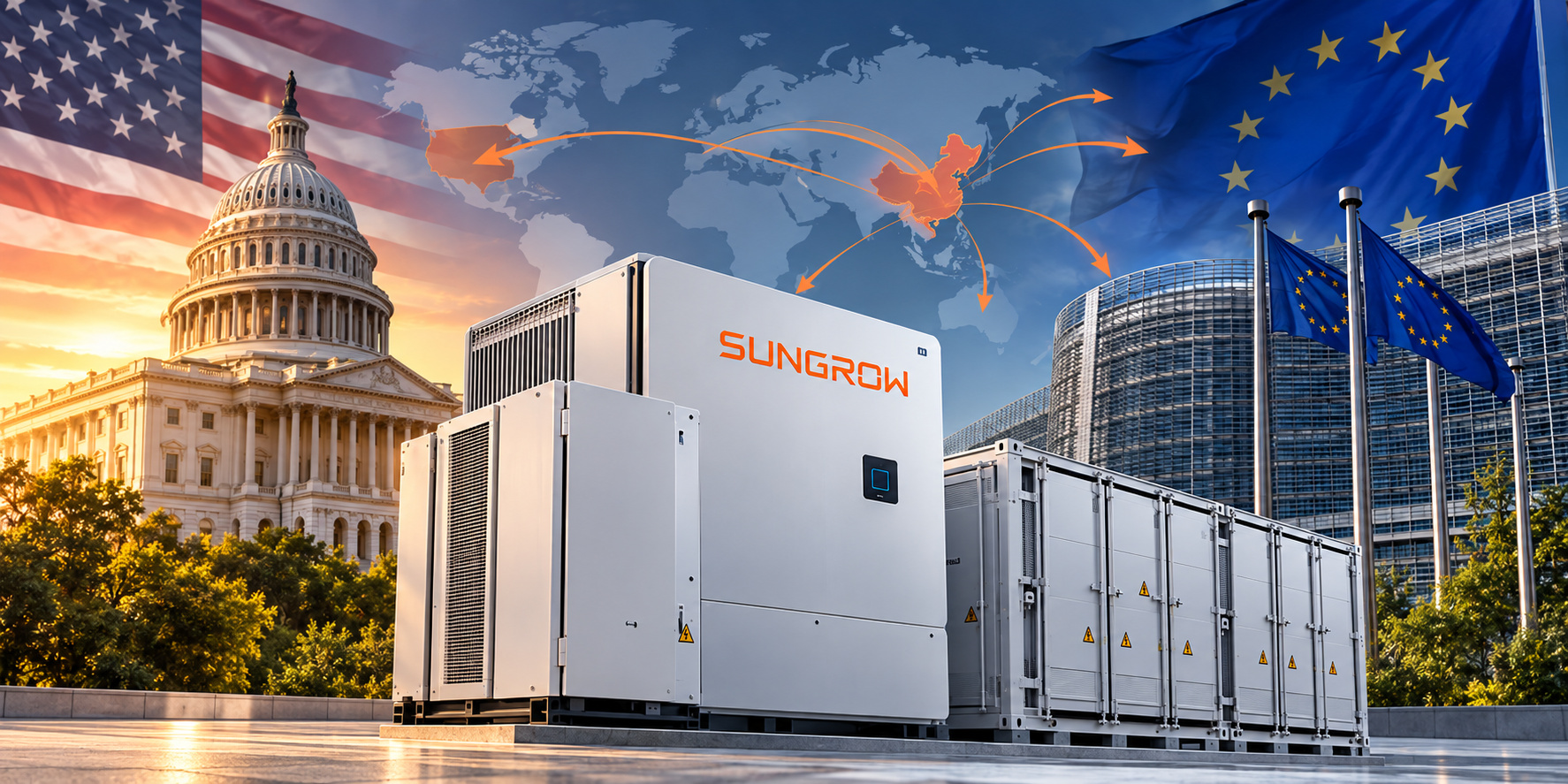
Sungrow's business has become increasingly dependent on overseas markets. That dependence is now being tested by a wave of US and European measures aimed at foreign inverter and energy storage suppliers.
The shift has been rapid. Overseas revenue rose 48.8% to RMB54.0 billion in 2025, while revenue from Mainland China fell 15.7% to RMB34.9 billion. Overseas markets went from 46.2% of group revenue in 2023 to 60.7% in 2025, and reached 73.4% in the first half of 2026. They are also where Sungrow makes its money, with a reported gross margin of 40.4% overseas against 18.8% in China.
Part of the shift reflects a retreat from the domestic market. Sungrow's inverter shipments in China fell about 19% in 2025, from 70 GW to 57 GW, even as China's new solar installations rose from 278 GWac to 317 GWac. The gap was sharper in energy storage. Overseas shipments nearly doubled from 19 GWh to 36 GWh, while domestic shipments fell from 9 GWh to 7 GWh. Sungrow has said that domestic storage margins were generally in the single digits and that some projects lost money.
The first half of 2026 took the trend further. Revenue from Mainland China fell 54.7% year on year to RMB8.22 billion, while overseas revenue fell a more modest 10.6% to RMB22.69 billion. PV inverters and energy storage now make up about 90% of group revenue, after revenue from the New Energy Investment and Development segment fell 85%.
As a result, Sungrow's growth now depends heavily on a small number of Western markets. The company does not disclose consolidated revenue by country, but other public figures give a sense of the exposure. In October 2025, Sungrow said the United States had contributed about 15% to 20% of total revenue in recent years, roughly RMB13.4 billion to RMB17.8 billion at 2025 levels. In Europe, eight subsidiaries reported about RMB13.86 billion of standalone revenue in 2025, led by Germany at RMB5.76 billion, the UK at RMB2.34 billion and Benelux at RMB2.01 billion.
Both regions are now raising barriers. In the United States, energy storage projects claiming Section 48E tax credits must limit sourcing from prohibited foreign entities. The required non-prohibited share starts at 55% for projects beginning construction in 2026 and rises to 75% by 2030. In July 2026, the Federal Communications Commission added foreign-produced connected power inverters to its Covered List, which blocks authorization of new models. In late August, Executive Order 14420 gave the government power to restrict or condition foreign equipment in the bulk power system, including inverters and battery storage.
Sungrow has said its existing certified US products are unaffected, but that certification of new products would be constrained. Management has also acknowledged that its US business may decline gradually over the longer term. Its share of the North American energy storage market had already fallen from 17% in 2023 to 10% in 2024.
Europe is taking a different route with a similar effect. EU funding is now restricted for projects using inverters from high-risk suppliers. Wood Mackenzie estimates this could affect more than 28 GW of EU solar demand, about 14% of the forecast for 2026 to 2030, and about 12% of energy storage deployment. A proposed revision of the EU Cybersecurity Act would go further, allowing suppliers to be assessed on their ownership and control, not only on where they manufacture.
That distinction limits how far Sungrow's mitigation strategy can go. The company announced a €230 million factory in Poland in February 2026, with annual capacity of up to 20 GW of inverters and 12.5 GWh of storage. If European rules focus on ownership, local production may not remove the high-risk label. In the United States, Sungrow plans to source Samsung SDI battery cells for its storage products, but the US sourcing test covers the whole system, including inverters, battery management and control electronics, not only the cells. Changing cell suppliers also does nothing for the separate FCC restriction on new inverters.
The market has already reacted. Sungrow's Shenzhen-listed shares fell 13.9% on 1 July after reports of a planned US import ban on foreign inverters, and about 12% on 27 August after the executive order was signed. By early September they were trading around RMB87, down about 55% from their late-May high.
The timing is awkward for Sungrow's planned Hong Kong listing. The company refiled its application in April 2026, but its listing document uses an April cut-off date that predates both the first-half results and the US and European measures. With H-shares typically priced at a discount to the A-share, the lower share price also reduces how much the company can raise.
For investors, the broader question is whether an overseas growth model can hold up as access to the largest Western markets narrows. Sungrow has built a profitable international business, but without market-level figures for revenue, margins and backlog in the US and Europe, it is hard to judge how much of that business is exposed, or where replacement growth would come from.
Intelligence Takeaway
The signal is less about a single headline and more about how decision-makers should read the operating environment: commercial claims, policy exposure, and execution evidence now need to be evaluated together.